
Ferrari car cover is not just a tarp to keep off sun and rain. With Ferrari, where every aerodynamic crease is intentional and each layer of clear coat is crafted like glass, a car cover functions as an external immune system that keeps your car in showroom condition despite harsh weather and varied usage environments across the United States. A proper cover must hug the body with custom-fit, control friction for true scratch resistance, allow moisture to escape for long-term clear coat protection, and remain safe for paint even if the car already has PPF or a ceramic coating. These four qualities do not live alone. They interweave and reinforce one another to create a complete protection system.

Related Articles: Bentley car cover: luxury, quality, finesse even while the car is covered
Overview of Ferrari

Ferrari is recognized by an aerodynamic design language: large wheel arches, deep airflow channels, sharp intakes, and complex surface transitions at the wing and tail. These lines are not just for looks. They generate specific pressure zones and vortices at speed, and they also make the body “picky” about anything that touches it, including a cover. On the paintwork, Ferrari often features finishes with high depth of clear coat. Some cars add ceramic layers or PPF for extra durability. All of this makes the surface sensitive to repeated micro movement and to trapped moisture. Any protective solution must respect two physical mechanisms at once: relative motion between fabric and paint, and the day-night cycle of condensation and evaporation.
From real-world use in the U.S., Ferrari owners face strong UV in the Sun Belt states like California, Nevada, Arizona, Texas, and Florida, but also pollen, tree sap, bird droppings, sea mist, sudden showers, and even snow and road salt in the Snow Belt. A cover that is “right for Ferrari” therefore needs to do several things at once. It must fit tightly to reduce flutter, use an ultra-soft liner to limit micro friction, breathe so moisture is not trapped, and employ careful seam architecture so there are no hard edges rubbing against panel lines.
Related Articles: BMW Car Cover Why a car in the garage still deteriorates and how to stop it at the source
Why Ferrari needs custom-fit instead of generic sizing
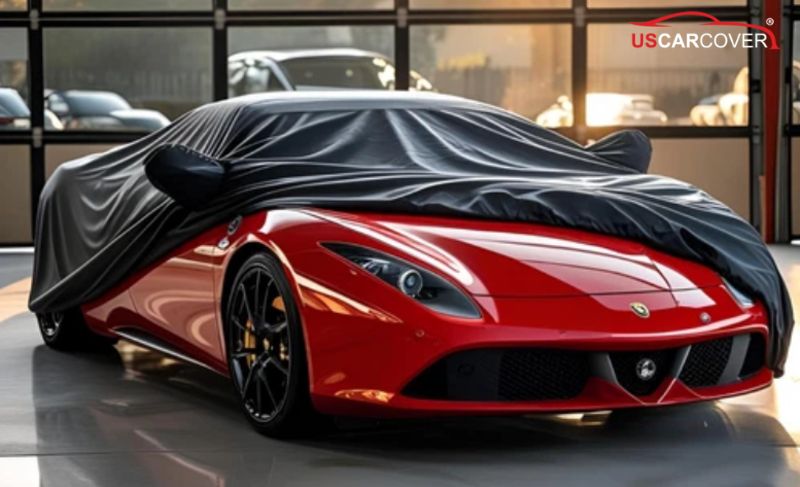
Imagine running long distance in a free-size shirt. A wide shirt will billow in the wind and repeatedly rub your skin. Ferrari behaves the same way. The body has convex areas like the top of the wheel arches, the hood edge, and raised side mirrors. If the cover does not fit closely, air will slip in and form small hollow pockets that behave like resonance chambers, causing the fabric to pulse steadily and create cumulative friction. For the first few weeks you might notice nothing. Under strong sun, however, faint halo-like swirls begin to appear around glossy curved areas. That is the direct result of fabric moving across paint.
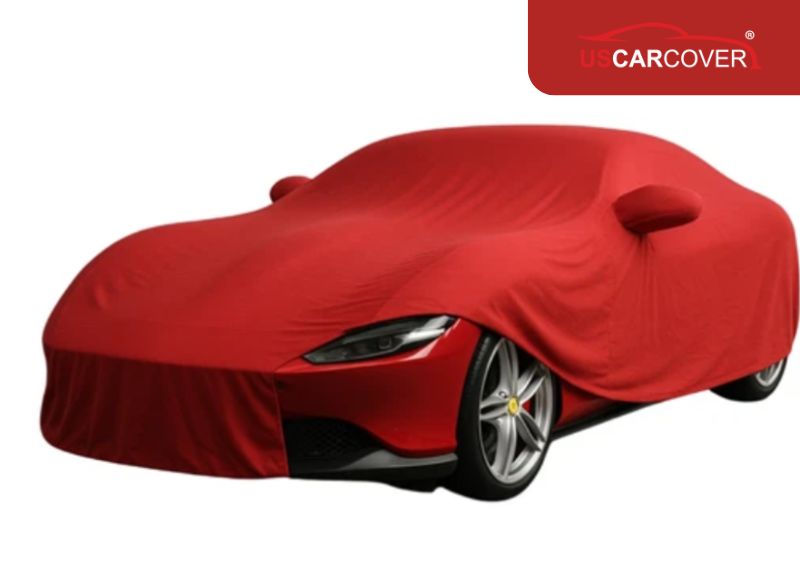
Custom-fit solves the vibration mechanism at its root. When a cover is patterned from a 3D scan of the body, with mirror pockets placed correctly, the proper drop at the tail, and allowances for aero features, with elastic hems that wrap the perimeter and optional underbody straps for windy regions, the fabric no longer has space to travel. Pressure is distributed evenly rather than concentrating at sharp edges, which are the most vulnerable points for clear coat. Protection improves and the user experience becomes quicker and more precise. You place the nose, align the mirrors, settle both sides, then secure the hem and straps. Everything clicks like a practiced routine. In a clean garage, a fitted cover even preserves the supercar silhouette, keeping the car tidy and reducing incidental touches from passersby.
Put simply, for Ferrari, custom-fit is the foundation that allows the other criteria to work. When you look at 458, 488, F8 Tributo, or 296, you are not looking at generic curves. You are seeing aerodynamic geometry that demands tailored coverage to prevent the tiny yet relentless motions that cause micro-marring over time.
Related Articles: Cadillac car cover: protect against dust and sand, tree sap, and animals, keep scratches away
Scratch resistance, properly understood: controlling friction in a realistic and scientific way

“Scratch-resistant” does not mean “cannot scratch.” Any woven material touching paint has the potential to generate abrasion if conditions are wrong, for example if you cover a car with construction dust on it after a long drive, or if you drag fabric sideways across a panel. Real scratch resistance is the combination of an ultra-soft liner, intelligent seam architecture, true body conformity, and daily habits that are clean, gentle, stable.
Start with the liner. The layer that touches clear coat must be extremely smooth, must not bleed dyes when damp, and must not stiffen over time. Touch should feel like premium microfiber or fine fleece, not like coarse weave. A proper liner does not snag fibers at panel edges. Next, seam architecture must prioritize recessed stitching and avoid placing joins at high-load zones such as the crown of the wheel arch or the front bumper corners. Every seam can become a potential hard point if it sits proud. Stitch density and how seams are tucked away truly matter.
Still, good fabric and neat seams are incomplete if the cover is loose. A custom-fit cover acts as the frame while the liner is the cushion. The frame keeps the cushion from sliding. Once the cover fits closely, wind cannot create meaningful lateral movement. When there is no lateral movement and when the surface is kept clean, the risk of swirl marks drops dramatically. In practice, most swirl does not come from a “bad” liner. It comes from covering a dusty car or from a billowing, oversized cover. A Ferrari car cover that truly resists scratches is one that makes it easy for you to do the right thing every day.
If the liner is the velvet glove, custom-fit is the skeleton, and user habits are the muscles. All three must work together to create real, durable scratch resistance instead of a promise that only holds in ideal lab conditions.
Related Articles: Bugatti car cover: Protection for Event Days and When Transporting by Trailer
Breathable yet safe for paint with the right water behavior
A common misconception is that water resistance should equal plastic-bag tightness. On paint, the true danger is not only the rain itself but the moisture that remains trapped afterward or that forms overnight through condensation. If a cover is too sealed, vapor gets stuck between liner and paint. This leads to musty odors, mineral rings as water dries, and can even accelerate light corrosion at metal edges.
The material must breathe. A micro-porous structure allows water vapor to migrate from paint to the outside while the outer face is treated to bead rainwater so droplets roll away. The goal is not to be bone dry the second a shower ends. The goal is to keep the paint dry in a long-term sense by avoiding moisture retention. After heavy rain, it is best to let the cover air dry before reusing it and to re-cover only when the car is clean and dry. That small habit protects clear coat more reliably than any “perfectly sealed” marketing claim.
Breathability also helps with heat management in outdoor parking. Midday sun can raise body temperatures quickly. A material that exchanges air reduces hot spots, which benefits paint, plastics, rubber, and interior trim. In the U.S., where cycles of strong sun, sea breeze, and cool mornings can occur within days, controlled water shedding plus active vapor escape is the formula that keeps Ferrari paint healthy.
Related Articles: Dual-Ghia car cover for long-term storage: quick-dry, no musty odor, no soft-top mildew
Paint safety for Ferrari, even with PPF or ceramic
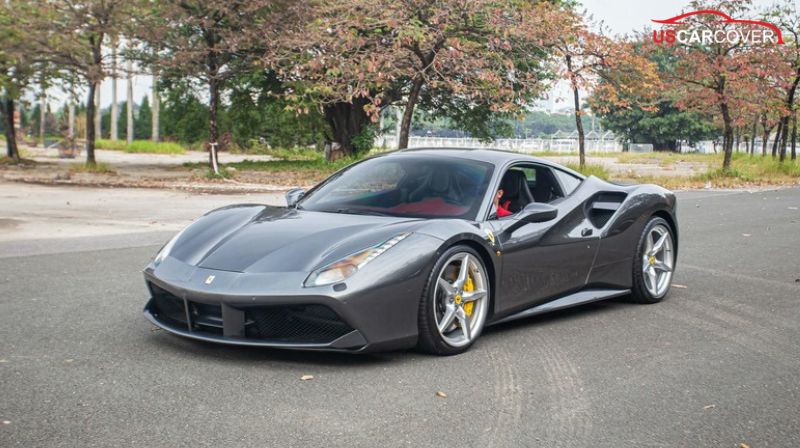
Many Ferrari owners in the U.S. have invested in PPF to block stone chips and in ceramic coatings to reduce grime adhesion and enhance gloss. A good cover must not merely avoid harm. It must be proactively compatible with both layers. With PPF, the sensitive area is the film edge. If a cover is wide and moves freely, repeated lateral rubbing at panel edges can make edges ripple over time. Custom-fit stabilizes the cover and distributes loads evenly, minimizing movement.
Material choices also matter. The liner must be non-bleeding to avoid dye transfer onto film or ceramic when damp. Recessed seams and soft-edged hems remove the hard “ridge” sensation that could rub against panel edges during handling or gusty conditions. On ceramic-coated surfaces, which are inherently water repellent, a smooth, clean liner works with the coating to reduce incidental garage contact. Matte paint deserves a special note. Since you cannot restore matte by polishing as you would a glossy clear coat, the safe approach is doubling down on cleanliness and gentle technique: ensure the surface is dirt free before covering, choose an ultra-soft liner, and avoid dragging the fabric laterally across panels. Here again, precise custom-fit marks the line between safe and risky by reducing unintended movement.
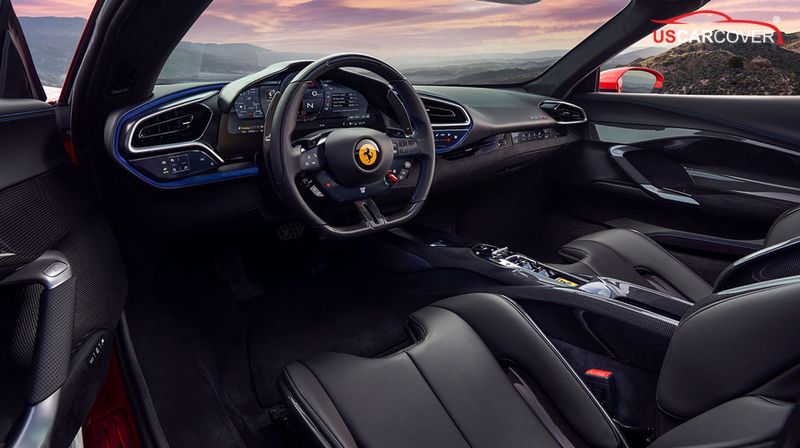
Remember this principle: a clean cover makes for safe paint. Clean the cover regularly, air dry it if it gets wet, and fold it in sections so the exterior does not touch the liner. These small routines keep PPF, ceramic, and original clear coat healthy for years.
Related Articles: Dodge car cover: Ultra durable, compact, lightweight, and designed to dissipate heat
How to choose a Ferrari car cover for real-world conditions in the U.S.
There is no single cover for every situation. Lifestyle, parking location, local climate, and use frequency are the variables to weigh:
- Frequent outdoor parking in the Sun Belt: prioritize strong UV resistance, breathable material, an outer face that sheds rain as beads, and underbody straps for wind.
- Clean indoor storage or collection display: prioritize an ultra-soft liner, light overall weight, and precise custom-fit that flatters the silhouette and encourages quick daily handling.
- Coastal or high-humidity areas: put breathability first to limit condensation and sea mist. Choose an outer face that shakes off fine salt easily.
- Windy regions: a precise custom-fit, snug elastic hems, and underbody anchoring form the required trio to eliminate long-duration flutter.
Regardless of configuration, daily practice is the same: clean, gentle, stable, well-ventilated. That is how theory becomes everyday reality.
FAQs
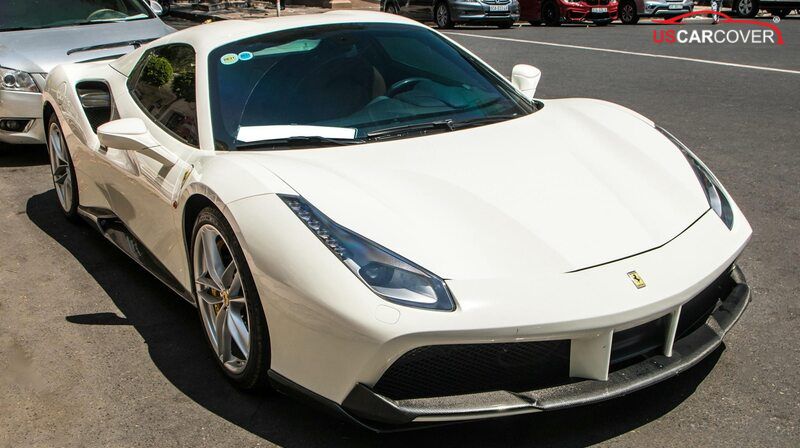
Does a Ferrari car cover actually prevent swirl marks?
- It can reduce them significantly when the cover is custom-fit with an ultra-soft liner, when the car is clean and dry before covering, and when you anchor the cover in outdoor wind. Scratch resistance is the outcome of material, design, and user habits working together.
Does a breathable cover let water in?
- A micro-porous fabric allows water vapor to escape so moisture is not trapped, while surface treatment helps rainwater bead and roll off. The objective is long-term dryness of the paint, not plastic-bag tightness
If my car has PPF or a ceramic coating, should I still use a cover?
- Yes. Choose a non-bleeding liner, recessed seams, soft hems, and a high-precision fit that does not stress film edges. On ceramic, a clean, smooth liner minimizes incidental contact in tight garages
Can I cover the car right after driving in the rain?
- You should not. Wait until the car is clean and dry before covering. Trapping water between liner and paint leads to musty odor and mineral spotting
Where to buy a car cover
- If you want a source that focuses on custom-fit car covers for many vehicle lines, including Ferrari, uscarcover.com is worth a look. On its home page, the company presents value points such as free shipping, a 30-day money-back guarantee, secure shopping, and live support. Messaging highlights Guaranteed Fit along with 100 percent Made in USA, fulfillment from a California warehouse, and more than 20 years of experience. These points are presented in the Why Choose section and across the primary banners on the home page

A worthwhile Ferrari car cover is not measured by a single trait like thickness or absolute water block. True value lives in balance and coordination: custom-fit to eliminate extra movement and stabilize surface contact, scratch resistance through an ultra-soft liner with intelligent seams and soft hems plus clean-gentle-stable handling, breathability that manages moisture correctly, and paint safety that remains compatible with PPF, ceramic, and even matte finishes. When these four pillars are connected by proper habits, covering only when the car is clean and dry, avoiding dragging, anchoring in wind, and drying the cover before storage, your Ferrari retains depth, gloss, and that showroom aura every time you unveil it.
In the diverse U.S. climate where strong sun, sea mist, sudden rain, and gusts take turns, a proper Ferrari car cover is a small investment that protects a very large one. You are not only safeguarding paint. You are preserving the feeling you get every time you look at your car. When that feeling remains intact year after year, a cover stops being an accessory and becomes an invisible immune system for your Ferrari. For a shorter path from theory to daily practice, choosing a specialist like USCarCover helps you put the right fit and the right habits in place from day one
